
Your Shopify store is growing.
At first, your supplier could handle 100 orders a day without much trouble. Products were available, orders went out on time, and communication was relatively simple.
Then your business started growing.
Your ads performed better. More customers discovered your products. Daily orders climbed from 100 to 300, then 500—and eventually, you started targeting 1,000 orders a day.
But your supplier is still operating as if your business were much smaller.
Production starts falling behind. Popular products go out of stock. Quality becomes inconsistent. Warehouse processing slows down, and shipping delays begin affecting customer satisfaction.
Suddenly, growth creates more problems than expected.
A supplier that can handle 100 orders a day is not automatically ready to support 1,000.
For growing Shopify brands, the challenge isn't simply finding a supplier that can deliver products. It's building a supply chain that can scale with demand.
In this guide, we'll explore what changes when your store grows from 100 to 1,000 daily orders, the warning signs that your supplier may be reaching capacity, and how to prepare your fulfillment operation for the next stage of growth.
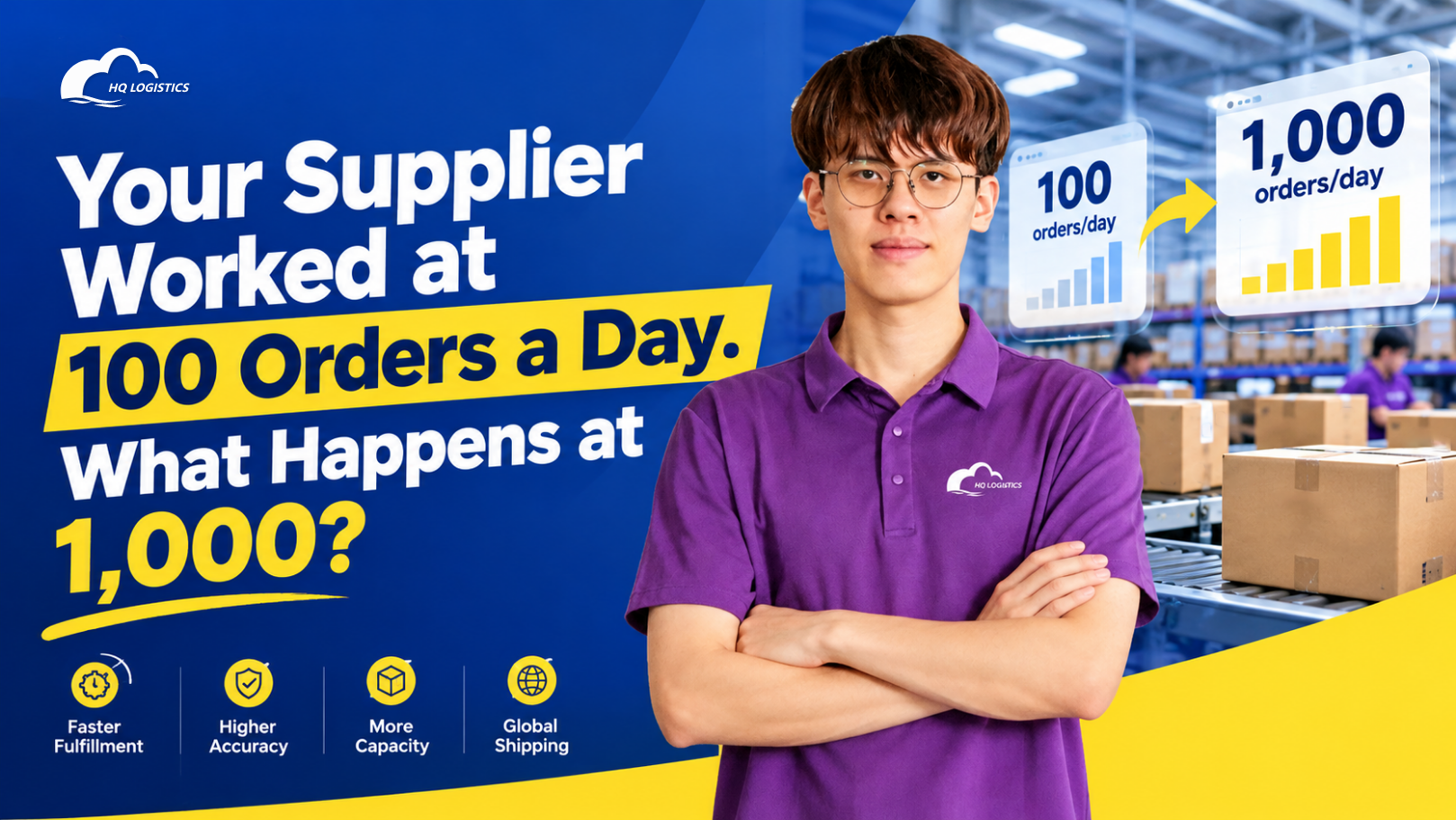
Moving from 100 to 1,000 orders per day means handling ten times as many orders. But the operational challenge can be more complicated than simply multiplying your workload by ten.
More orders can mean more SKUs, more inventory movements, more supplier communication, more packaging requirements, and more pressure on every part of your fulfillment process.
Consider the difference:
| Operational Area | Around 100 Orders/Day | Around 1,000 Orders/Day |
|---|---|---|
| Sourcing | A small supplier network may be sufficient | More supplier capacity and backup options may be needed |
| Production | Smaller replenishment batches | Larger, more carefully scheduled production runs |
| Inventory | Manual tracking may still be manageable | Accurate inventory visibility becomes increasingly important |
| Quality Control | Problems may be easier to isolate | Small defect rates can affect many more orders |
| Warehousing | Basic picking and packing may work | Layout, staffing, systems, and capacity need careful planning |
| Shipping | A limited number of routes may be sufficient | Route selection, carrier capacity, and contingency planning matter more |
| Communication | Direct, informal coordination | Clear processes, ownership, and regular reporting become essential |
These are not fixed thresholds. A store's actual requirements depend on product complexity, order composition, SKU count, and fulfillment model.
The key point is that your supply chain needs to evolve as your order volume grows.
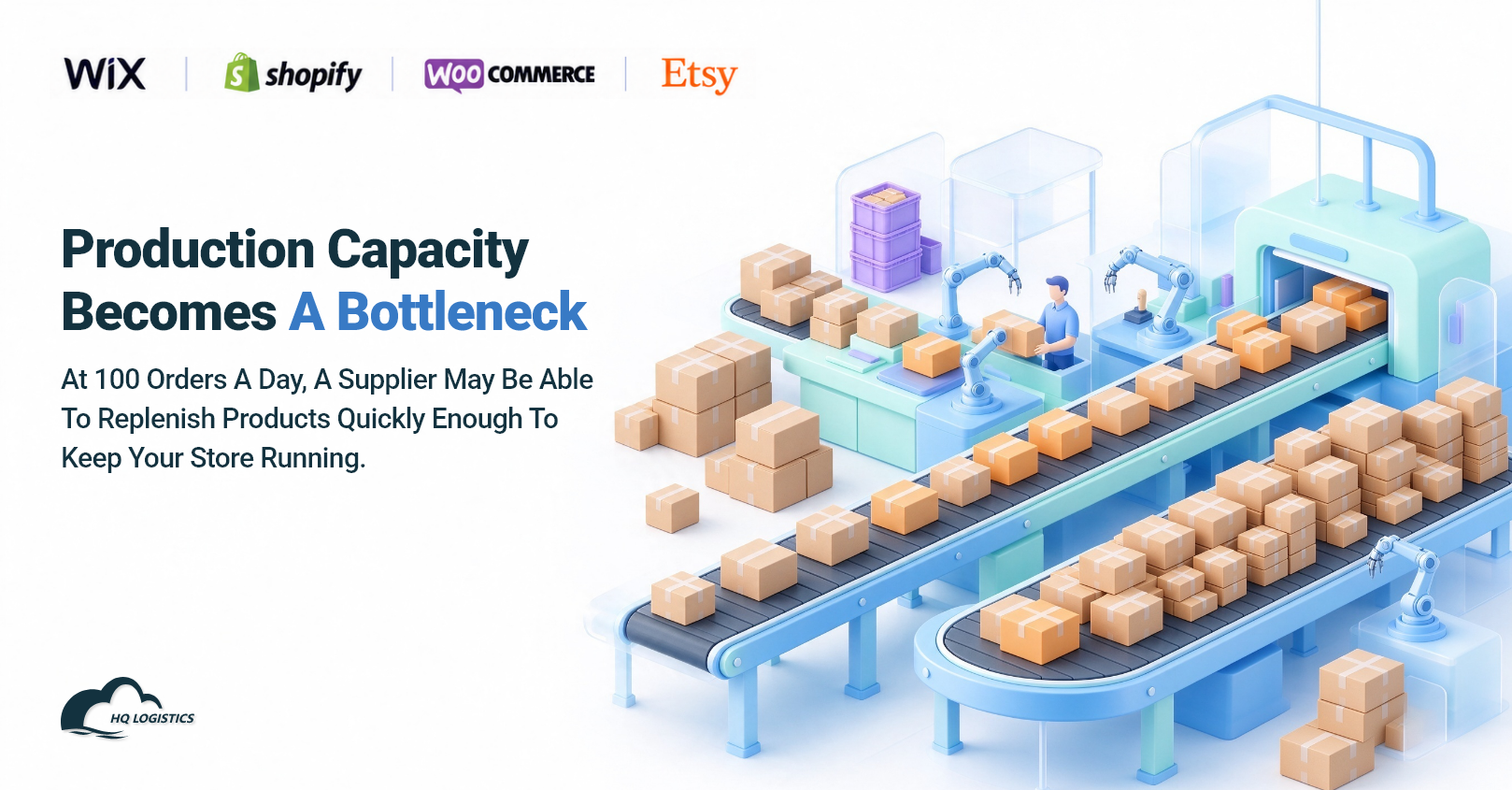
At 100 orders a day, a supplier may be able to replenish products quickly enough to keep your store running.
At 1,000 orders a day, the same supplier may struggle to keep up—especially if several of your products sell well at the same time.
Production capacity can be affected by raw material availability, factory schedules, labor, packaging preparation, and other customers competing for production resources.
Longer lead times:
Your supplier needs more time to produce and prepare inventory.
Stockouts:
Your bestsellers sell faster than replenishment can arrive.
Missed promotions:
Inventory is not ready when a major campaign begins.
Emergency purchasing:
You need to arrange additional stock at short notice, potentially reducing your negotiating flexibility.
Start by sharing sales forecasts with your suppliers before demand increases. Confirm production capacity, minimum order quantities, lead times, and replenishment schedules.
For important SKUs, consider qualifying backup suppliers before you urgently need them.
A supplier should not only be able to fulfill your current orders. It should have a realistic plan for supporting your expected growth.
At 100 orders a day, you may be able to monitor stock levels with basic reports and regular supplier communication.
At 1,000 orders a day, inventory can change much faster.
A bestseller may lose hundreds of units in a short period. Several SKUs may need replenishment simultaneously, while incoming shipments are still in transit or waiting for warehouse receiving.
Without accurate inventory information, you may face overselling, delayed orders, and unnecessary emergency shipments.
Available inventory, committed inventory, incoming stock, sales velocity, supplier lead times, and reorder points should all be visible to the people responsible for replenishment.
A simple reorder point formula is:
Reorder Point = Average Daily Demand × Replenishment Lead Time + Safety Stock
For example, if a product sells 100 units a day and replenishment takes 10 days, expected demand during that lead time is 1,000 units. You would then add an appropriate safety-stock buffer based on demand variability and your tolerance for stockout risk.
The formula is a starting point, not a guarantee. Demand spikes, supplier delays, and warehouse receiving time should also be considered.
Not every product needs the same inventory plan.
Proven bestsellers:
Prioritize availability and regular replenishment.
Growth products:
Monitor demand closely and adjust stock based on actual performance.
New products:
Start with controlled quantities until demand becomes clearer.
Long-tail products:
Avoid tying up too much capital in inventory that sells slowly.
The objective is to keep enough stock to support growth without creating unnecessary inventory costs.
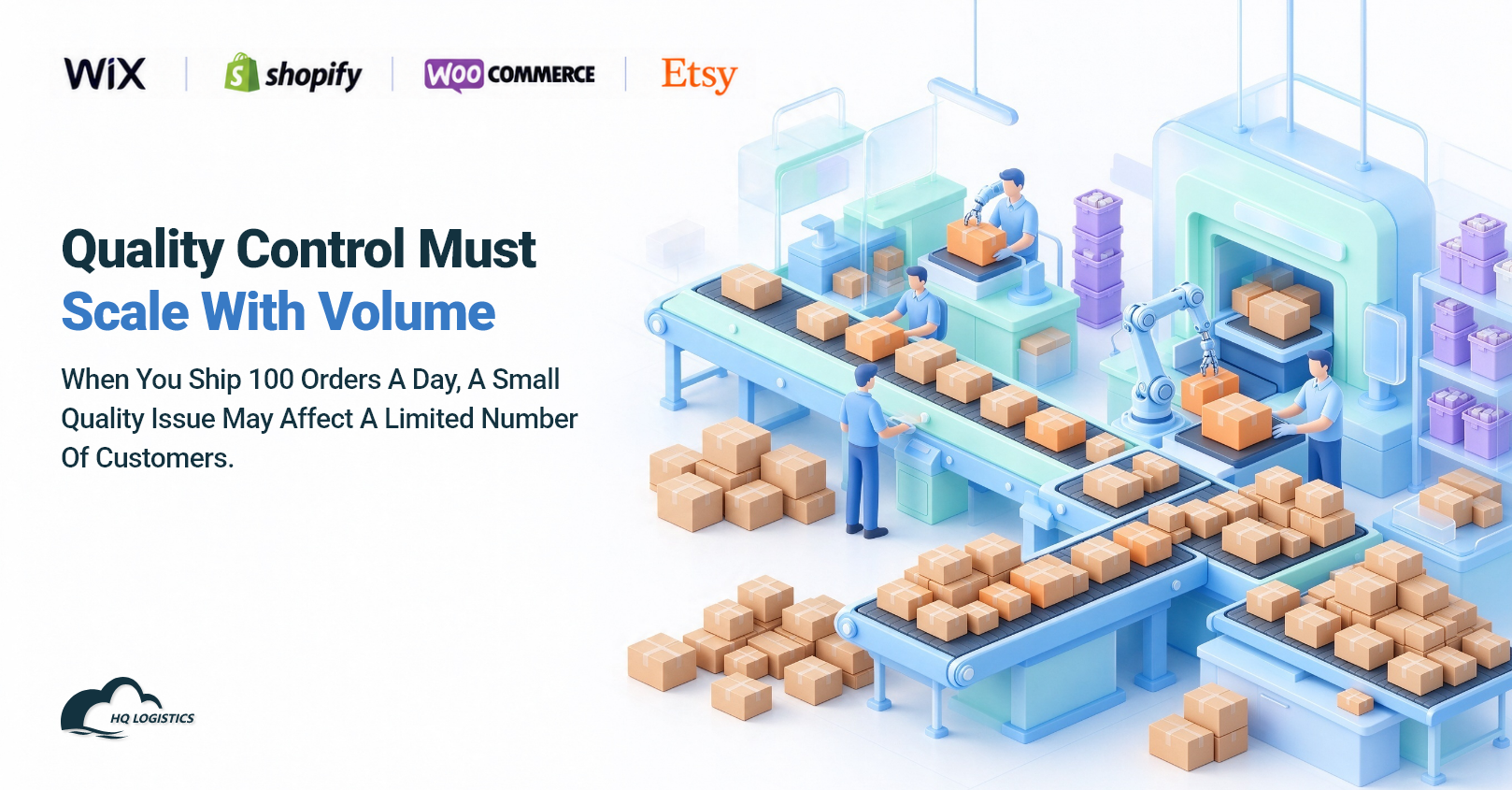
When you ship 100 orders a day, a small quality issue may affect a limited number of customers.
When you ship 1,000 orders a day, the same defect rate can create a much larger number of complaints, returns, and replacement requests.
Imagine that a product has a 2% defect rate. At 100 units, that represents approximately two defective units. At 1,000 units, it represents approximately 20.
The example is illustrative, but it shows why quality consistency becomes increasingly important as volume rises.
Product appearance, dimensions, materials, functionality, accessories, labels, packaging, and order quantities may all require inspection, depending on the product.
For repeat orders, use consistent product specifications and inspection criteria so that new batches match the approved sample.
Quality checks should be planned at appropriate points in the supply chain, such as before shipment from the supplier and before inventory is released for fulfillment.
If a problem is detected, defective inventory should be identified and isolated before it is sent to customers.
Scaling successfully means increasing order volume without allowing quality standards to slip.
More orders require more picking, packing, labeling, and shipping activity.
But hiring more warehouse staff alone may not solve the problem.
If SKUs are poorly organized, inventory counts are inaccurate, packaging materials run out, or order information is delayed, adding people may simply create more congestion.
Slow picking | Incorrect items | Packing backlogs | Poor SKU organization | Packaging shortages | Delayed tracking updates | Inaccurate stock records
A growing operation benefits from organized storage locations, clear SKU identification, accurate inventory records, standardized packing procedures, sufficient packing materials, and defined exception-handling processes.
Order management and warehouse systems can also reduce repetitive manual work by synchronizing order details, inventory, fulfillment status, and tracking information.
A typical workflow looks like this:
Shopify Order → Order Sync → Inventory Allocation → Pick & Pack → Shipment → Tracking Sync
Before your order volume reaches its target, test the entire workflow under realistic operating conditions.
Don't wait for your busiest sales day to discover that your warehouse process cannot keep up.
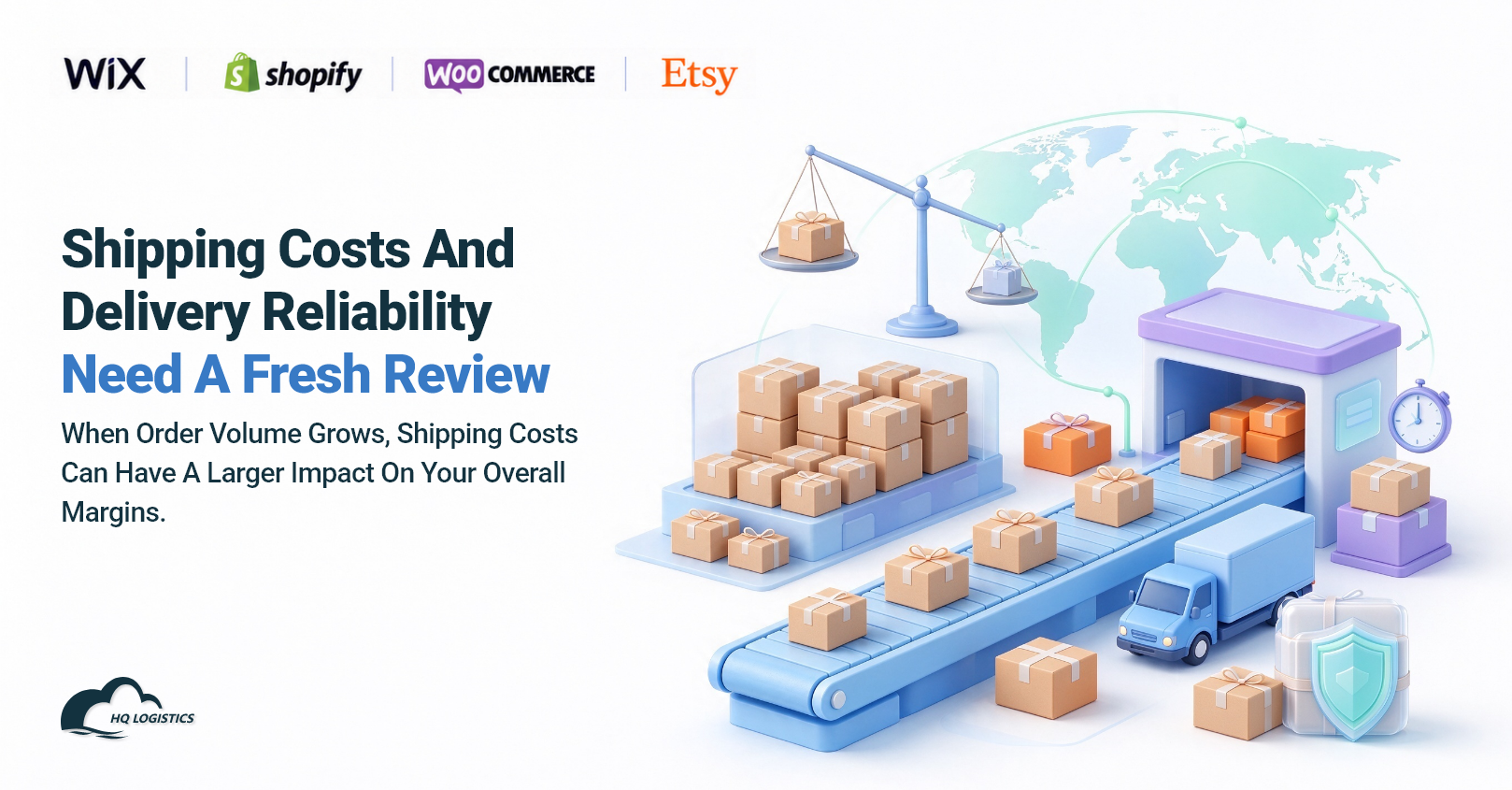
When order volume grows, shipping costs can have a larger impact on your overall margins.
A route that works well for smaller shipments may not be the best option for larger inventory movements or a different product mix.
Your shipping strategy should account for product weight and dimensions, destination, delivery deadlines, product restrictions, shipment volume, and the total cost of getting an order to the customer.
For new or unpredictable products, direct shipping from China may offer flexibility because you do not need to pre-position large quantities overseas.
For proven bestsellers with consistent US demand, shipping inventory in bulk to a US warehouse may allow individual orders to be fulfilled domestically once stock has arrived and been received.
For brands serving European customers, EU inventory positioning may also be worth evaluating.
A hybrid model can look like this:
China Inventory → Product Testing and Replenishment
US Warehouse → US Customer Fulfillment
EU Warehouse → European Customer Fulfillment
The right setup depends on demand distribution, product characteristics, inventory turnover, and total landed cost. Moving inventory overseas is not automatically cheaper for every product.
The important thing is to evaluate shipping and inventory placement together instead of treating every customer order as an isolated shipment.
At lower order volumes, a few messages and spreadsheets may be enough to coordinate daily operations.
As your store grows, the number of decisions increases.
Your supplier needs to know which products are growing, when replenishment is required, which packaging specifications apply, and how production schedules may change.
Your warehouse needs to know what is arriving, which SKUs are priorities, and how much capacity to prepare.
If these teams operate with different information, small communication gaps can turn into costly delays.
Share demand forecasts regularly. Standardize product specifications. Confirm production and shipping milestones. Define who is responsible for resolving exceptions. Review inventory and fulfillment performance on a consistent schedule.
For a growing brand, a supplier relationship should become more structured as order volume increases.
You should not have to start every replenishment cycle from scratch.
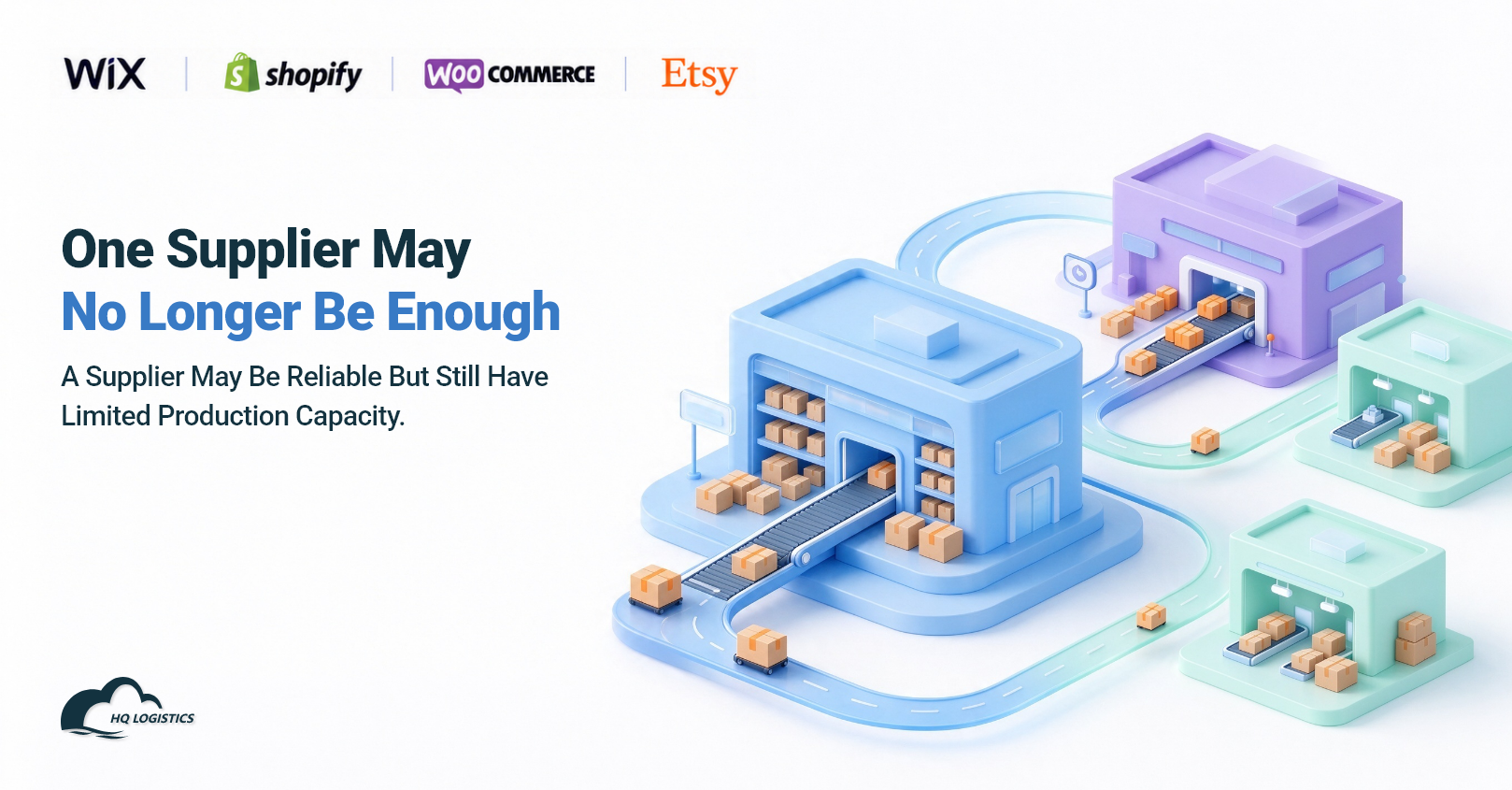
A supplier may be reliable but still have limited production capacity.
This is why growing brands should evaluate whether their supplier network is resilient enough to support their most important products.
A backup supplier can provide an alternative if the primary source experiences delays, quality problems, or capacity constraints.
However, adding suppliers also creates extra work. Different factories may use different materials, production processes, and packaging standards.
Before placing orders with a backup supplier, verify product specifications, samples, quality expectations, lead times, and commercial terms.
A coordinated sourcing partner can help manage these relationships and compare alternative suppliers when necessary.
The goal is not to use as many suppliers as possible. It is to reduce unnecessary dependence on a single source while maintaining consistent quality and control.
As your store grows, your fulfillment partner should be involved in planning—not only in shipping orders after they arrive.
Before scaling toward 1,000 daily orders, review the following:
Capacity:
Can the operation handle your forecasted daily and peak order volumes?
Inventory:
Are stock levels, incoming shipments, and reorder points visible?
Quality:
Are product specifications and inspection standards documented?
Warehousing:
Are storage, picking, packing, and receiving processes ready for higher volume?
Shipping:
Are the routes suitable for your products, destinations, and deadlines?
Technology:
Can order, inventory, and tracking data be synchronized reliably?
Contingency planning:
What happens if a supplier, warehouse, or shipping route experiences a disruption?
The answers should be specific to your business. Ask for realistic capacity estimates, service-level expectations, and a clear process for handling exceptions.
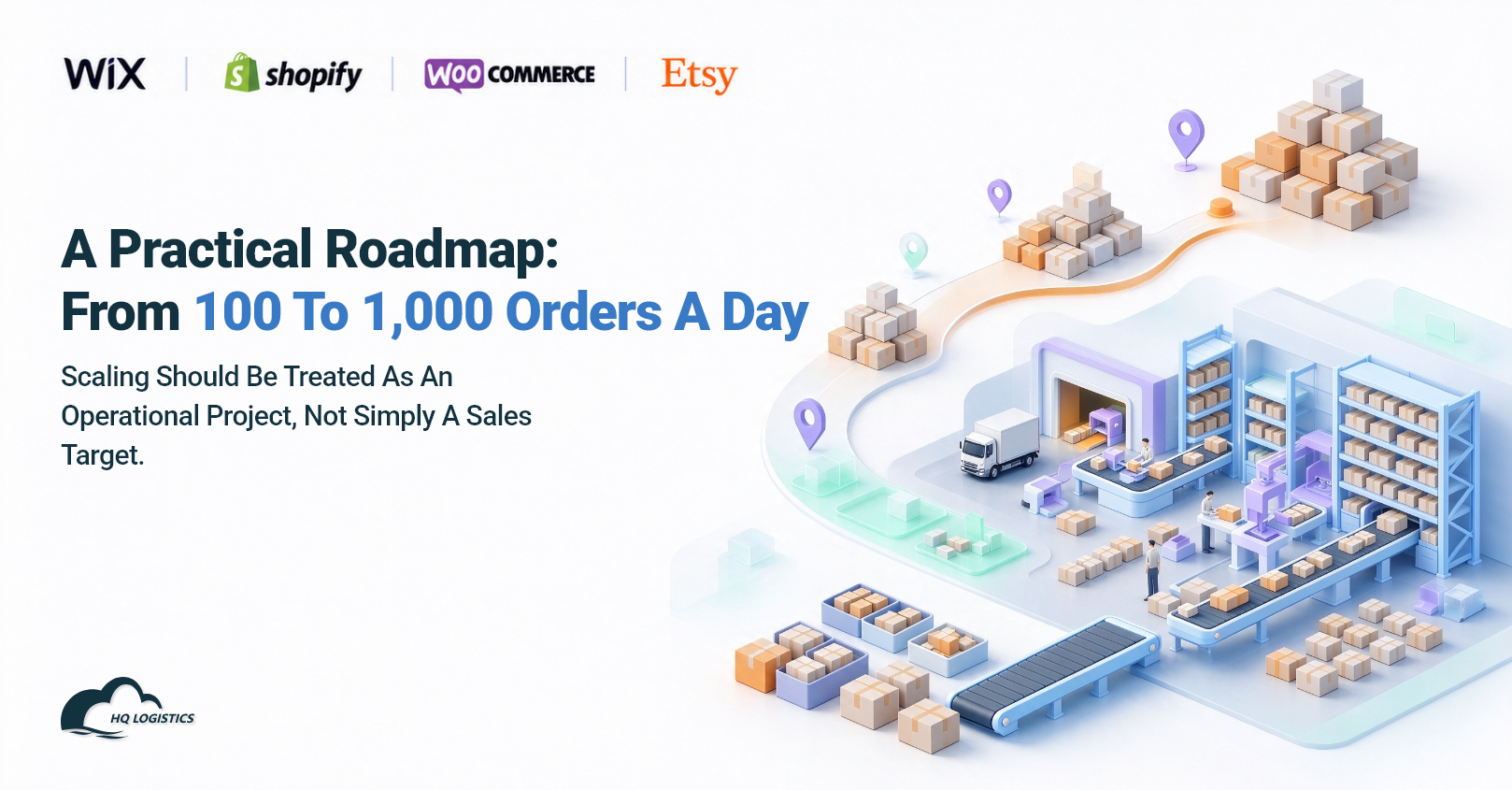
Scaling should be treated as an operational project, not simply a sales target.
Document product specifications, confirm reliable suppliers, measure actual fulfillment costs, and establish baseline metrics for order accuracy, defect rates, processing time, and delivery performance.
Identify bottlenecks, forecast demand by SKU, qualify backup suppliers for critical products, improve inventory visibility, and test whether warehouse processes can handle higher daily volume.
Confirm supplier production plans, reserve appropriate warehouse and fulfillment capacity, automate repetitive workflows where possible, and prepare suitable shipping options for each destination.
Track actual demand against forecasts. Review stockouts, late orders, inventory accuracy, defect rates, and total cost per delivered order. Adjust purchasing and fulfillment plans as the business evolves.
These stages are illustrative rather than universal milestones. A store with a small number of simple SKUs may scale differently from a store selling hundreds of product variations.
When your store grows from 100 to 1,000 daily orders, you may need more than a supplier that can deliver products.
You need a supply chain that connects sourcing, quality control, inventory, warehousing, fulfillment, and shipping.
HQ can support Shopify brands with:
Product sourcing and supplier coordination | Quality inspection | Inventory planning and consolidation | China warehousing | US overseas warehousing | Custom packaging and branding | Shopify integration | Order fulfillment | Tracking synchronization | Global shipping solutions
A connected workflow can look like:
Sourcing → Quality Control → Inventory Planning → Warehousing → Fulfillment → Global Shipping
For eligible products and services, HQ also offers two months of free US overseas warehouse storage. Eligibility and service conditions should be confirmed before inventory is shipped.
The right setup depends on your order volume, product range, customer locations, and inventory strategy. Some brands may benefit from direct shipping for new products and overseas warehousing for proven bestsellers. Others may need stronger supplier coordination or better warehouse workflows first.
The objective is to build a fulfillment model that fits your business today while preparing for the volume you want to handle tomorrow.
Your supplier may have performed well at 100 orders a day. That does not automatically mean the same setup will work at 1,000.
As your Shopify brand grows, production capacity, inventory accuracy, quality control, warehouse efficiency, shipping strategy, and supplier communication all become more important.
The solution is not necessarily to replace every supplier or move all your inventory overseas.
Start by identifying the bottleneck, measuring your actual performance, and upgrading the parts of the supply chain that limit growth.
More orders should not mean more chaos.
Build the systems, supplier relationships, and fulfillment capacity your next stage of growth requires.
Scale demand. Strengthen your supply chain. Fulfill with confidence.
Possibly, but you should verify production capacity, staffing, inventory availability, warehouse throughput, technology, and shipping arrangements. Current performance at 100 orders a day is not enough to establish readiness for ten times the volume.
There is no single challenge for every business. Common bottlenecks include production lead times, stockouts, inconsistent product quality, warehouse processing capacity, and poor inventory visibility.
Not automatically. First identify the actual bottleneck and discuss a capacity plan with your current supplier. Consider alternatives if the supplier cannot meet your documented requirements or provide a credible path to improvement.
Order volume alone does not determine whether overseas warehousing makes sense. Consider the share of your orders going to the US, product demand stability, shipping costs, inventory turnover, and the cost of holding stock overseas.
Forecast demand, standardize product specifications, maintain appropriate safety stock, qualify backup suppliers for critical products, improve inventory visibility, test warehouse workflows, and review performance regularly.
Track order accuracy, processing time, on-time shipment rate, inventory accuracy, stockout frequency, product defect rate, return rate, and total cost per delivered order. These metrics can help identify which parts of your supply chain need attention first.
📩Email: zoye@fulfllment-cn.com
PREVIOUS RECOMMENDATIONS


supplier capacity for ecommerce, scaling from 100 to 1000 orders a day, Shopify fulfillment, ecommerce supplier management, fulfillment capacity, ecommerce supply chain, inventory planning, supplier sourcing, quality control, warehouse fulfillment, US warehouse fulfillment, China fulfillment, Shopify order fulfillment, scalable fulfillment partner




Customer's favorable comments is our eternal motivation. We feel grateful for all the support and company.

Lorem ipsum dolor sit amet, consetetur sadipscing elitr, sed diam nonumy eirmod tempor invidunt ut labore et dolore magna aliquyam erat, sed diam voluptua.